Astronomers capture clearest image yet of Betelgeuse's companion star
ListenAutomatic voice
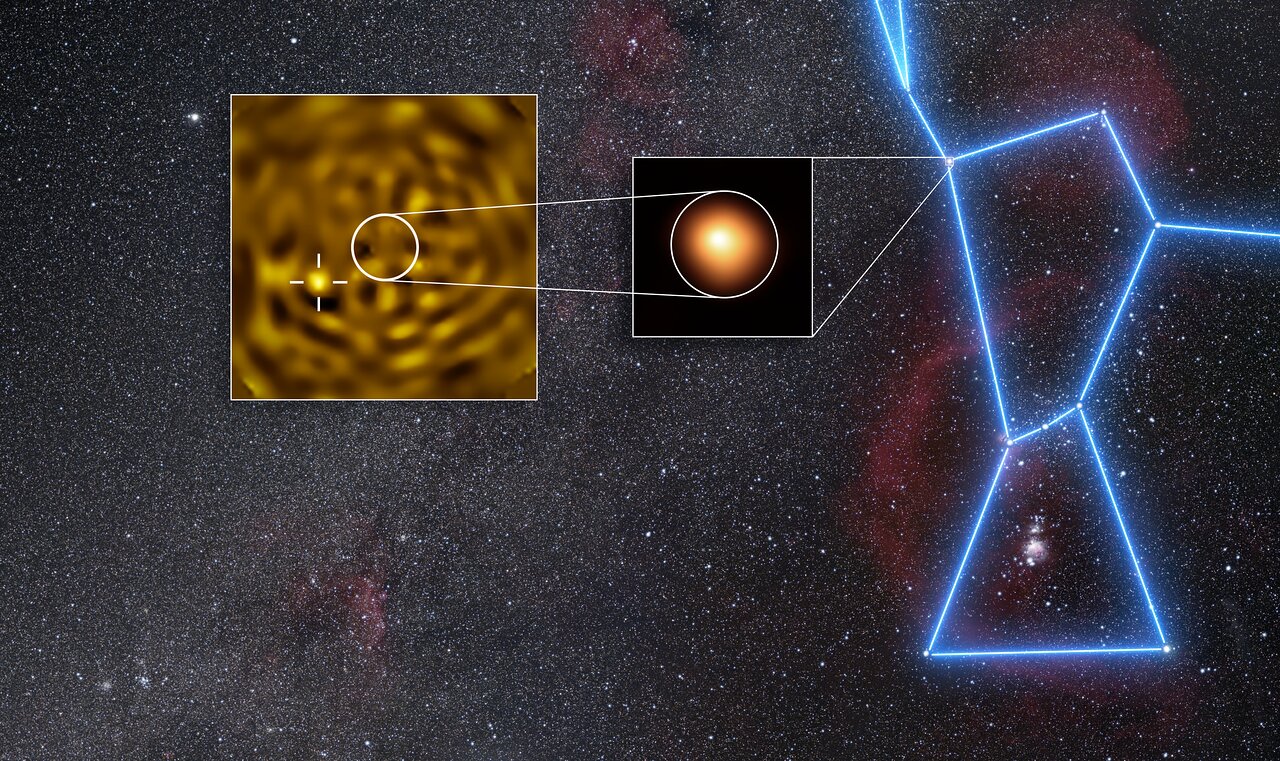
Betelgeuse is a famous red star in the night sky. People can see it without a . Now astronomers have strong that it is not alone.
A team uses a very large telescope in Chile. They take a clear picture of a second star. This star moves around Betelgeuse. Its name is Betelgeuse B.
Astronomers look for this star for about 100 years. It is two to three times heavier than the Sun. The team wants to it again in one year.
After about a of searching, astronomers obtained firm evidence that Betelgeuse, one of the most famous stars in the night sky, has a . A team led by French researcher Miguel Montargès used the European Southern Observatory's Very Large Telescope in Chile to take the clearest image yet of the second star, which is called Betelgeuse B.
The companion was first in order to explain why Betelgeuse changes in brightness. Two studies in 2024 that it would be furthest from Betelgeuse that December, so the team observed the star then and spent months the data.
The results, which were published in Astronomy & Astrophysics, showed that Betelgeuse B has two to three times the mass of the Sun, more than expected. Nevertheless, the team still wants to observe it again in a year to be certain.
After roughly a century of searching, astronomers say they have firm evidence that Betelgeuse, the reddish star in Orion that is easily visible to the naked eye, has a . A team led by Miguel Montargès of the Observatoire de Paris used the SPHERE instrument on the European Southern Observatory's Very Large Telescope in Chile to capture the clearest image so far of the fainter star, known as Betelgeuse B. The findings were published in Astronomy & Astrophysics.
A companion was originally suggested to account for Betelgeuse's in brightness. Two studies in 2024 predicted it would be at its greatest that December, so the team observed then and spent several months processing the data, using techniques first developed to find exoplanets. Montargès admitted he had doubted the telescope was enough. The detection succeeded because Betelgeuse B is heavier than forecast, at two to three times the mass of the Sun rather than about one.
Earlier evidence included a possible direct detection by the Gemini North Telescope in Hawaii. To be certain, the team still wants to observe the companion on the other side of Betelgeuse in a year. Betelgeuse, an evolved supergiant, is expected to end in a , and astronomers will now examine how its companion might influence that explosion.
Difficult words
- telescope
- a tool for looking at things far away in space
- evidence
- facts that show something is true
- companion
- something that stays together with another
- observe
- to watch carefully