Astronomers find a double ring of debris around a dead star
ListenAutomatic voice
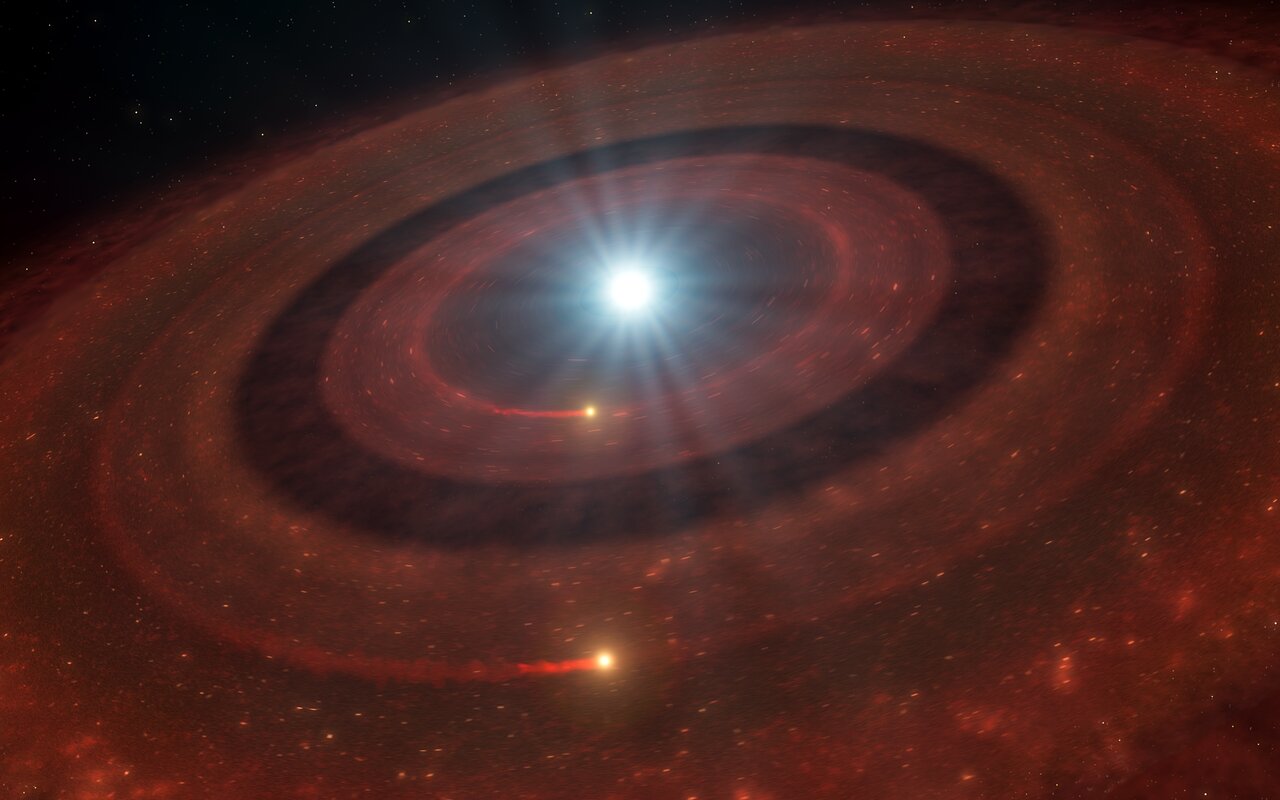
Astronomers find something around a dead star. The star is a white dwarf. That is the small, heavy left after a star dies.
Around it are two rings of . Debris means broken pieces. The pieces come from planets that once circled the star. A clear separates the two rings.
Two small bodies probably keep the rings in shape. One may be as big as Pluto. Our Sun will become a white dwarf one day. So this shows a possible future for our Solar System.
Astronomers using the European Southern Observatory's Very Large Telescope in Chile discovered a rare disc of around a dead star. The star, a white dwarf called J1328−1450, is the core that remained after a star like our Sun ran out of fuel.
While other dead stars have a single ring of debris, this one was surrounded by two rings, separated by a clear gap. According to the team, the structure is probably by two bodies. The inner one is thought to be a few kilometers wide, whereas the outer one could be as large as Pluto or the Moon.
The study, which was published in Nature Astronomy, matters because the Sun will also become a white dwarf in the far future. Consequently, the system offers a of what may happen to our Solar System.
Astronomers have identified a rare double disc of around a dead star, a discovery that hints at the eventual of our own Solar System. The observations were made with the X-Shooter instrument on the European Southern Observatory's Very Large Telescope in Chile's Atacama Desert, and the study appeared in Nature Astronomy.
The star, J1328−1450, is a white dwarf: the dense, burnt-out core left when a Sun-like star its fuel. Such stars swell and shed their outer layers as they die, destroying nearby planets, and the rocky bodies that survive can break apart into a disc. Every debris disc previously known around a white dwarf showed the of a single flat ring. Here, two gaseous rings remain and separated by a gap, probably held in place by two surviving bodies, one a few kilometers across and the other possibly as large as Pluto or the Moon.
The disc contains calcium, oxygen, magnesium and iron, much like rocky material in the Solar System. Yet the inner ring is rich in magnesium while the outer one has largely lost it, suggesting the debris came from two different planets, or from different layers of one. Lead author Nicola Gentile Fusillo said it was the first example of such a complex system.
Difficult words
- rare
- not seen or found often
- core
- the central part of something
- debris
- broken pieces left after something is destroyed
- gap
- an empty space between two things