Astronomers find a third, very faint planet around the star Beta Pictoris
ListenAutomatic voice
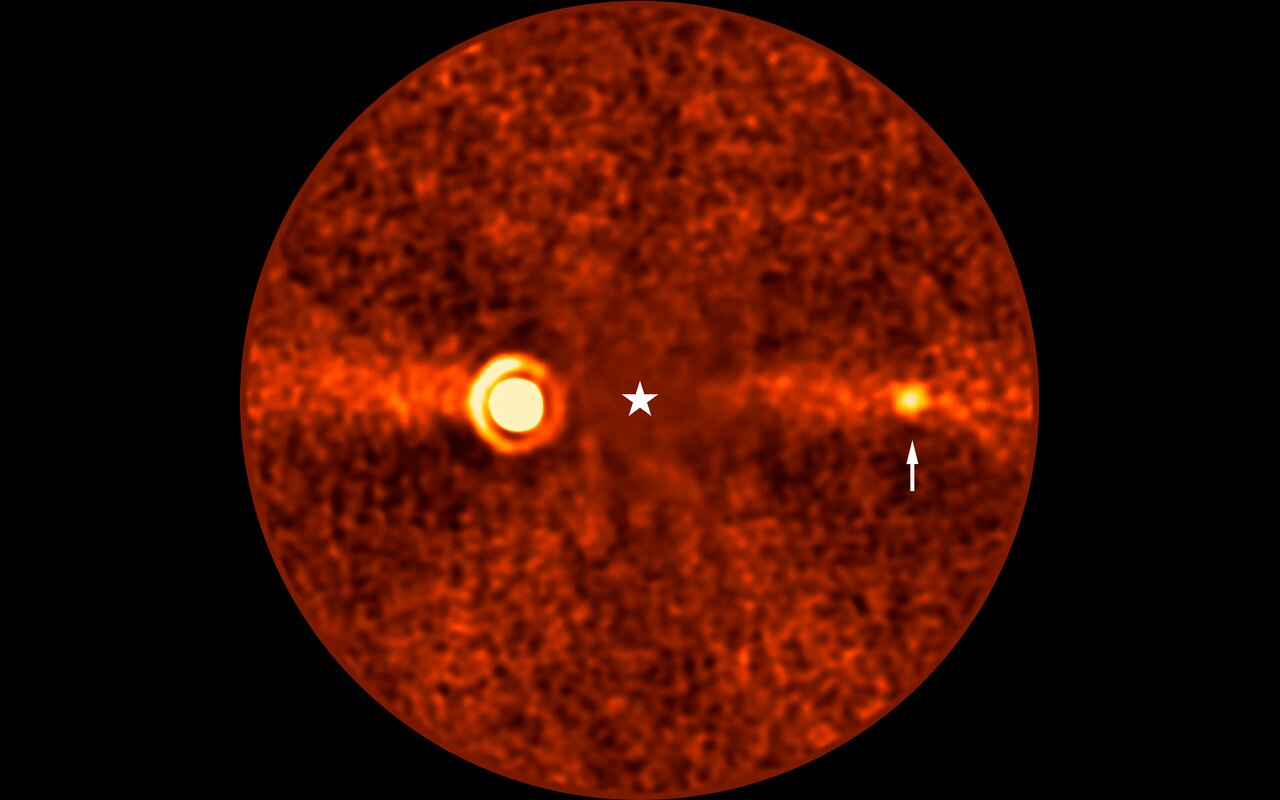
Astronomers find a new planet around the star Beta Pictoris. It is the third planet there. Its name is Beta Pictoris d. The star is 63 from us.
The planet is a gas , like Jupiter. It is cold and very . Faint means it gives little light. It is the faintest planet ever photographed from Earth.
The team finds it by . They are studying another planet near the same star. Later, they look at old pictures. The planet is there too, in pictures from 11 years ago.
Astronomers discovered a third planet the star Beta Pictoris, which is 63 light-years away. The new planet, Beta Pictoris d, was first spotted with the European Southern Observatory's Very Large Telescope, and it is the faintest ever imaged directly from Earth.
The discovery was . The researchers had originally planned to study a known planet, Beta Pictoris b, but they noticed something else in their images. When they searched the ESO , they found the new planet in several older observations, some of which dated back 11 years.
Like its two neighbors, Beta Pictoris d is a gas giant. However, it has a much wider orbit and only 2.4 times the mass of Jupiter, while the others are about ten times as . A separate team also found it using the James Webb Space Telescope.
Astronomers have discovered a third planet circling Beta Pictoris, a star 63 light-years away, and it is the faintest ever imaged directly from Earth. Named Beta Pictoris d, it is 100 times fainter than Beta Pictoris b, the first planet found in the system. The study, co-led by Ben Sutlieff of the University of Edinburgh and Markus Bonse of the European Southern Observatory, was published in The Astrophysical Journal Letters.
The find was . The team had set out to how Beta Pictoris b changes over time, using the ERIS instrument on ESO's Very Large Telescope, when they noticed a separate object in their images. Searching the ESO , they located the planet in observations going back 11 years, including data from another instrument, SPHERE. An group led by Aidan Gibbs at the University of California detected the same planet with the James Webb Space Telescope.
Like its siblings, Beta Pictoris d is a gas giant, but it travels on a much wider orbit and has only 2.4 times the mass of Jupiter, against roughly ten for each of the others. It is also relatively cold, which explains its . Because direct imaging only works for planets bright enough to stand out beside their host star, photographing so faint a world is a notable achievement.
Difficult words
- giant
- something very large
- light-years
- very long distances that light travels in one year
- faint
- not bright and hard to see
- chance
- luck, without a plan