Hubble maps crowded heart of the Milky Way to prepare for Roman telescope
ListenAutomatic voice
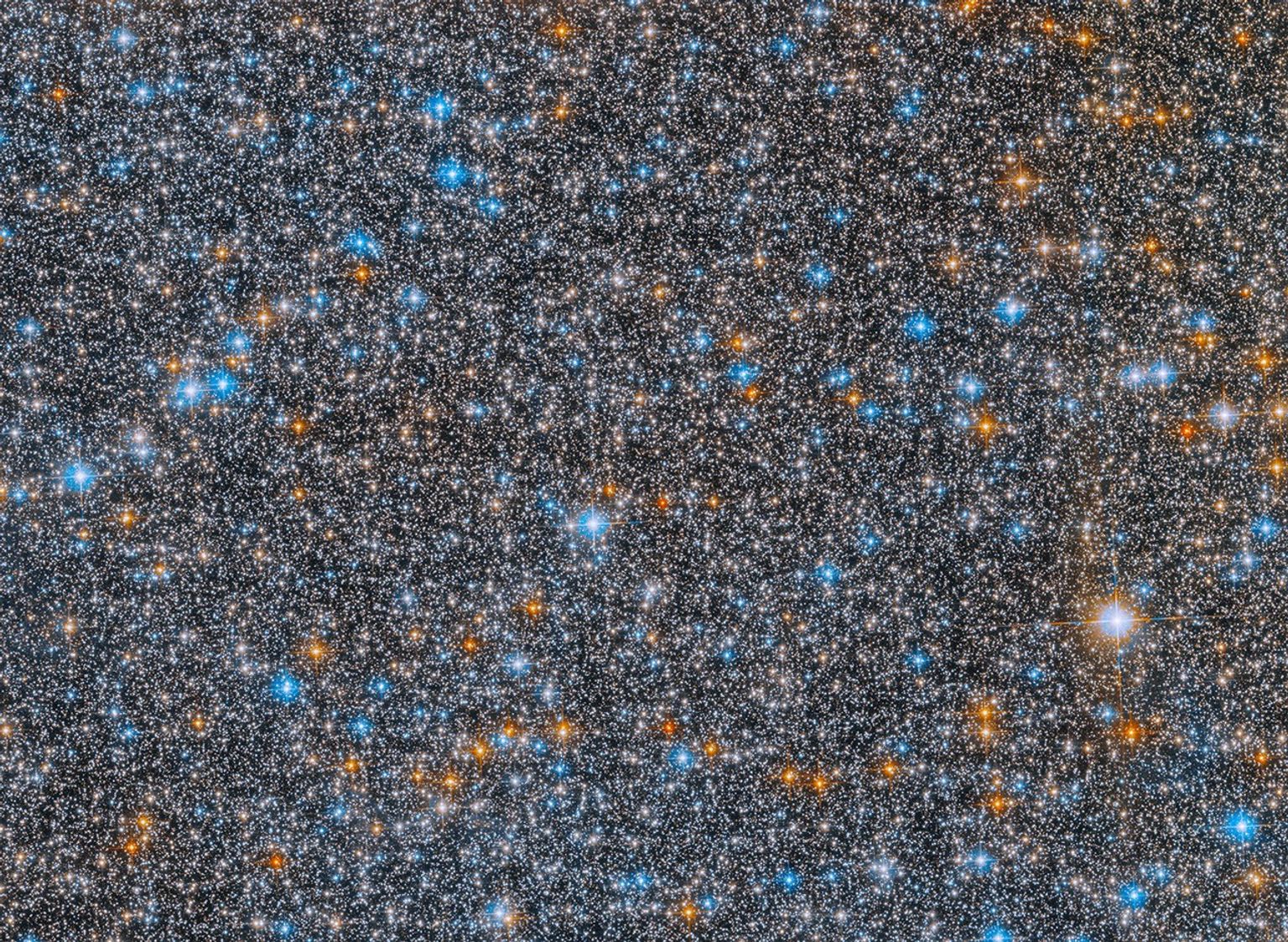
The Hubble Space takes new pictures of the Milky Way. They show an area near the center of our galaxy. This area is called the galactic . It is a round packed with stars.
The bulge holds almost a quarter of the galaxy's star mass. It is also close enough to study in detail. Hubble can see single stars there.
The pictures will help a future telescope called Roman. Roman will look at the same area. It will search for , planets around other stars.
NASA released images from the Hubble Space Telescope that showed countless stars near the center of the Milky Way. The pictures focused on the galactic bulge, a packed, round region of stars around the middle of the galaxy's disk.
The observations were part of a designed to help researchers understand future data from the Nancy Grace Roman Space Telescope. Since scientists want to compare the two sets of results, Hubble observed the area in red visible light and near-infrared light, which Roman will also collect.
Astronomers study the bulge because it contains nearly a quarter of the galaxy's mass and is close enough to examine in detail. In addition, Roman will look for there by recording microlensing events, in which the mass of a nearer object the light of a more distant one.
New images from NASA's Hubble Space Telescope reveal a dazzling of stars toward the galactic bulge, the densely packed, roughly region that surrounds the center of the Milky Way's disk. The observations belong to a survey intended to lay the for the upcoming Nancy Grace Roman Space Telescope, which will study the same crowded part of the sky.
The bulge attracts astronomers because it contains nearly a quarter of the galaxy's stellar mass and lies close enough to be examined in detail. Similar structures glow in other galaxies, but they are too distant and too tightly packed for individual stars to be . Hubble's sharp vision lets its instruments record the brightness, ages, composition and motion of stars over time, information that can help locate black holes or dark matter and trace how the galaxy has evolved.
To make comparison possible, Hubble observed in the that overlap with Roman's sensitivity: the red end of the visible spectrum and the near-infrared. A central goal for Roman is to find exoplanets through microlensing, in which the mass of a nearer object magnifies and light from a more distant star. The pattern of that distortion can offer clues about the foreground star and any planets circling it.
Difficult words
- telescope
- a tool for looking at things far away in space
- bulge
- a round part that sticks out
- region
- a large area
- exoplanets
- planets that go around stars other than the Sun