Satellite image shows Georgia's pecan orchards at harvest time
ListenAutomatic voice
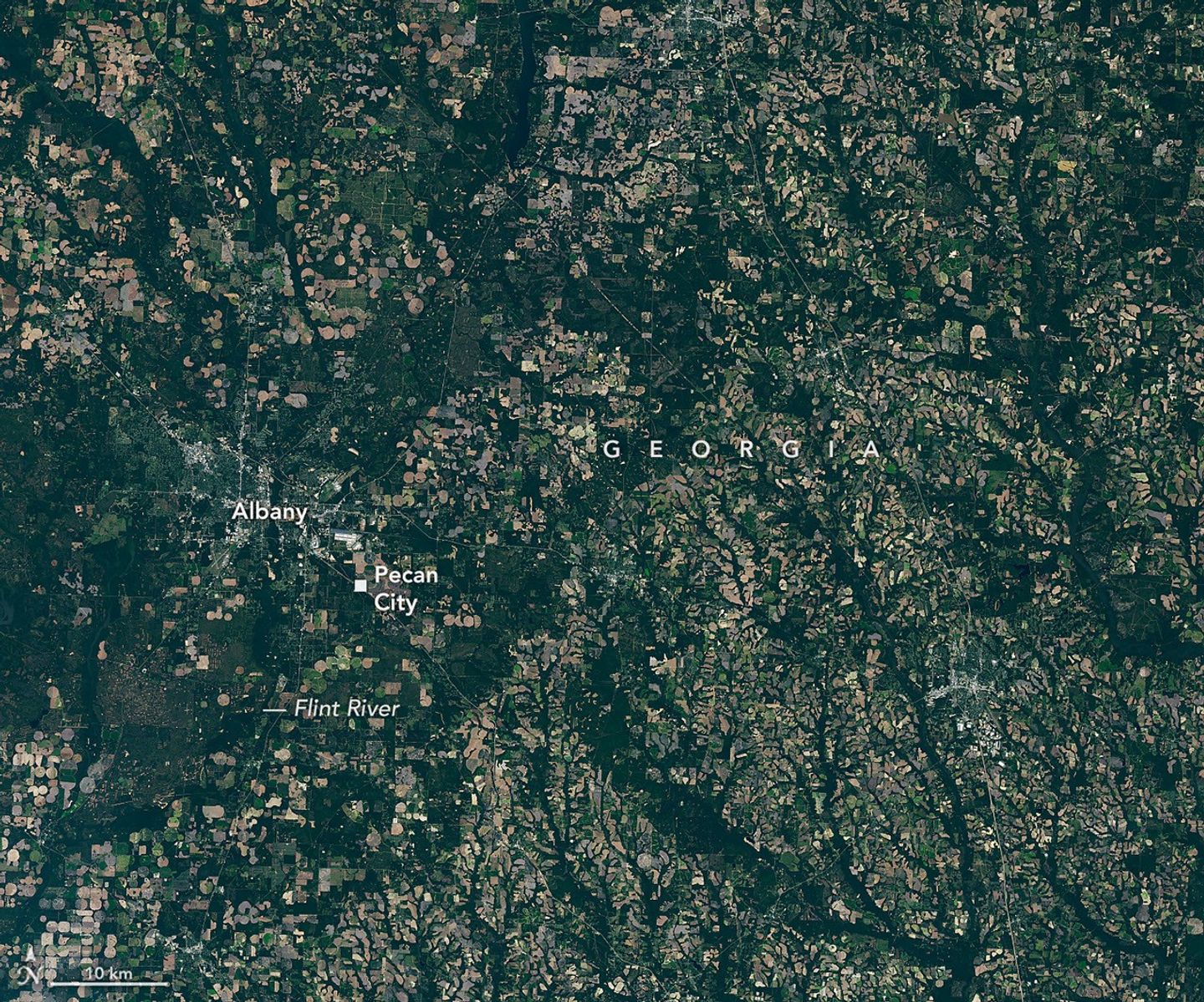
Pecans are nuts that grow on trees. Many people in the United States eat them at Thanksgiving. Many of these nuts come from the state of Georgia.
A NASA image shows farms near the city of Albany. A takes the picture on October 23, 2026. This is season, when farmers collect the nuts. Farmers there also grow peanuts, cotton and corn.
Pecan trees need a lot of water. The sandy in this area is good for them. Storms and a plant make problems for some farmers.
NASA published a satellite image of pecan in southwest Georgia, a state that has led the United States in pecan production. The picture was taken by Landsat 8 on October 23, 2026, during the harvest season, which usually lasts from October into December.
The orchards lie around the city of Albany, where peanuts, cotton and corn are also grown. Pecan trees need plenty of water, and they do well in the area's sandy soils, which sit above an that growers use for .
Georgia had fewer than 100 acres of pecan orchards in the late 1800s, but by the end of the 1950s it was the country's top producer. Although damaged orchards in 2018 and 2024, production has stayed above 100 million pounds in each of the past three years.
A Landsat 8 image released by NASA's Earth Observatory captures the pecan orchards of southwest Georgia during the harvest, just as the nut takes its traditional place on Thanksgiving tables. Acquired on October 23, 2026, it shows the land around Albany, in Dougherty County, where pecan share the landscape with fields of peanuts, cotton and corn.
Pecans grow on Carya illinoinensis, a hickory native to North America, and the trees demand abundant water. They in the region's well-drained sandy soils above the Floridan aquifer system, which growers tap for . A 2025 crop map from the U.S. Department of Agriculture, built partly on Landsat observations, shows groves along the Flint River.
Georgia had under 100 acres of pecan orchards in the late 1800s, before a planting boom in the early 1900s. By the end of the 1950s it led the nation, producing more than 17 million pounds according to 1959 census figures. New Mexico and Texas have since expanded, and hurricanes Michael in 2018 and Helene in 2024 Georgia's orchards, yet output exceeded 100 million pounds in each year from 2023 to 2025. In 2026 a wet summer encouraged scab, a disease, although some growers hit by Helene reported a solid crop again.
Difficult words
- satellite
- a machine that moves around Earth in space
- harvest
- the time when farmers collect what they grow
- soil
- the earth that plants grow in
- disease
- a sickness